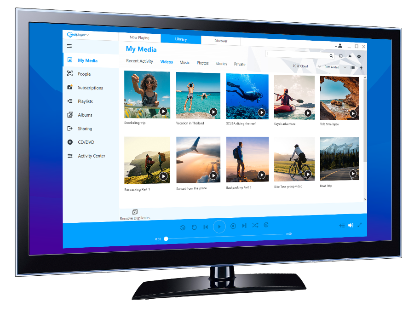
With embedded playback, you can weave your clips through your Web page's text and graphics, and add controls such as stop and start buttons. It's as if you took RealONE Player apart and placed its pieces at different spots on your page. This chapter explains how to add markup to a Web page so that people can view your streaming presentation directly through their Web browsers.
To embed streaming media in your Web page, you first produce your clip or
clips. You can even use SMIL to put together an entire presentation containing
multiple clips. You then embed your presentation by adding <EMBED> tags to
your Web page, and using HTML commands to place your clips and various
RealONE Player controls on your page.
You add to your Web page one <EMBED> tag for each playback window you
want in your page, and one <EMBED> tag for each control, such as a Stop
button, that you want to include. When you use <EMBED>, your presentation
will work in browsers that support the Netscape plug-in architecture,
including the following:
Note:
Even when you use the <EMBED> tag, RealONE Player
communicates with the Internet Explorer browser using
ActiveX technology. This makes the Netscape <EMBED> tag
compatible with both major browsers.
|
<EMBED> tags are an extension of HTML. Because they are not SMIL tags, they
do not use the same syntax rules as SMIL. The <EMBED> tag parameters are
typically in this form:
PARAMETER=value |
Parameter names can be any case, although this manual shows them uppercase. Except for file names, which typically must be lowercase, parameter values are not case-sensitive. Unless they are URLs, parameter values do not need to be enclosed in quotation marks.
When you embed a presentation, you use HTML to structure your Web page and define where each streaming clip and RealONE Player control appears. A common practice is to define an HTML table, embedding clips and RealONE Player controls in various table cells. When you embed a SMIL presentation, you can define a layout using SMIL and HTML, or just HTML alone.
As described in Chapter 11, you can use SMIL to define an overall media
window size (the root-layout). You might create a layout that is 400 pixels wide
by 300 pixels high, for example, and define smaller regions within that main
area for clips. You then embed the entire playback area within your Web page
using a single <EMBED> tag, adding RealONE Player controls around it with
separate <EMBED> tags. All clips then appear within that 400-by-300 pixels
area, just as they would when played in RealONE Player. In fact, your SMIL file
can play in both your Web page and RealONE Player.
| For More Information: See "Defining the Layout with SMIL". |
You can leave layout information out of your SMIL file, and use SMIL simply
to define your presentation timing and other playback features. In your Web
page, you then create a separate <EMBED> tag for each clip, placing each clip
anywhere on your page. In this case, all clips do not need to appear within a
rectangular root-layout area. This gives you more layout flexibility than when
defining the overall clip layout through SMIL. However, because your SMIL
file lacks layout information, it may have unexpected layout results if played
directly in presentation.
| For More Information: See "Defining the Layout with HTML". |
In addition to clips, you can embed many different RealONE Player buttons, sliders, and information panels in your Web page. You might include separate start, stop, and pause buttons in your Web page, for example. Or, you could add entire control panels that contain multiple buttons and readouts. You can make these controls any size you want, too, giving you even more layout flexibility. The section "Adding RealONE Player Controls" explains all the available controls.
RealONE Player supports Javascript, which enables you to extend the <EMBED>
tag capabilities. You can use Javascript to turn your own graphic image into a
RealONE Player Play button, for example. RealONE Player also includes an
ActiveX control that provides playback capabilities for the following products:
This production guide does not explain these capabilities. For information on using Javascript or ActiveX with an embedded presentation, see the RealPlayer Javascript and ActiveX Reference Guide, which is available for download from the following Web page:
http://service.real.com/help/library/encoders.html
Each <EMBED> tag has three required parameters, and can include many
optional parameters, which are described throughout this chapter. The
following table lists the parameters to include in every <EMBED> tag.
| Parameter | Value | Function | Reference |
|---|---|---|---|
HEIGHT |
pixels |
Sets the height of the clip or control. | click here |
NOJAVA |
true|false |
Keeps the Java virtual machine turned off. | click here |
SRC |
filename.rpm |
Gives URL to the Ram file (.rpm). |
click here |
WIDTH |
pixels |
Sets the width of the clip or control. | click here |
A basic <EMBED> tag looks like the following, which creates a playback area 320
pixels wide by 240 pixels high within the Web page:
<EMBED SRC="presentation.rpm" WIDTH=320 HEIGHT=240 NOJAVA=true> |
You must include the SRC parameter in every <EMBED> tag, even when the tag
embeds a RealONE Player control instead of a clip. However, you don't specify
a clip or SMIL file directly with SRC. Instead, you specify a Ram file that has a
.rpm extension. This causes the browser to use RealONE Player as a helper,
rather than launch it as a separate application. The .rpm file is a simple text
file that gives the full URL to your clip or SMIL file.
| For More Information: For background on Ram files, see "The Ram File". |
The easiest means for developing your embedded presentation is to keep your
clips in the same folder as your Web page on your desktop computer. Your
<EMBED> tag can then link to a .rpm file in that folder:
<EMBED SRC="presentation.rpm" WIDTH=300 HEIGHT=134> |
To embed a single video, for example, the .rpm file simply contains a local file
URL to the clip (the file:// protocol designation is required):
file://video.rm |
When you are ready to deliver your presentation to your audience, move your files to their respective servers and change the URLs in your files.
If you plan to keep the .rpm file with the Web page, you do not need to change
the SRC values in your <EMBED> tags. You can simply transfer your .rpm file and
your Web page to the same directory on your Web server.
If you move the .rpm file to a different directory than that Web page, link each
<EMBED> tag's SRC parameter to the .rpm file with a full HTTP URL:
SRC="http://www.example.com/media/sample.rpm" |
No matter where you put your .rpm file and your clips, modify the .rpm file to
give the fully-qualified URL to the embedded clip or SMIL file. If the clip or
SMIL file is on a Web server, use an HTTP URL. If the clip or SMIL file is on
RealServer, use an RTSP URL.
Tip:
Always use a full URL in the .rpm file, even if all files and
clips are in the same directory on a Web server. RealONE Player
uses the .rpm file to locate the clip or presentation. Without a
fully-qualified URL, RealONE Player must construct the
location from the original Web page URL and the information
in the .rpm file. This creates more possibility for errors.
|
| For More Information: For more information on URLs in .rpm files, see "Launching RealONE Player with a Ram File". The section "The Difference Between RTSP and HTTP" explains why RealServer uses the RTSP protocol instead of a Web server's HTTP protocol. |
If you will make your presentation available to people on their local machines
(through a download or a CD, for instance), you do not need to change any
URLs from those described in "Developing Your Presentation". In rare cases,
though, you may want to use an absolute link, rather than a relative link, in
the .rpm file. When using absolute links, use forward slashes in paths to create
"Web style" paths. For example, instead of this URL:
file://c:\media\first.rpm |
file://c:/media/first.rpm |
When your embedded clips reside on a RealServer that uses the Ramgen
feature, you can eliminate the .rpm file when you deliver your presentation.
Your SRC parameter uses an HTTP URL to the clip or SMIL file on RealServer,
and includes a /ramgen/ parameter along with the ?embed option:
SRC="http://realserver.example.com:8080/ramgen/sample.smil?embed" |
The HTTP protocol is required because a browser cannot make an RTSP
request. When /ramgen/ is used, though, RealServer causes the browser to start
RealONE Player as a helper application, then streams the clip or SMIL file to
RealONE Player using RTSP. Consult your RealServer administrator for the
correct URL to your RealServer.
| For More Information: For details on using the Ramgen option, see "Using Ramgen for Clips on RealServer". |
Required for each <EMBED> tag, the WIDTH and HEIGHT parameters set the size
of the playback area. If you omit these parameters, the playback area may
appear as a tiny icon because streaming media presentations do not resize
themselves automatically. The values for WIDTH and HEIGHT are in pixels by
default, so a width of 300 creates a playback area 300 pixels wide. Setting
WIDTH and HEIGHT to 0 (zero) hides the playback area.
You can also express WIDTH and HEIGHT as percentages of the browser window
size. For example, a width of 50% makes the width of the presentation area
half the width of the browser window. Keep in mind that different types of
media scale with different results. For example, a video scaled larger than its
encoded size may not look good. Vector-based clips such as Flash animations,
on the other hand, scale more easily to fit different playback areas.
Setting the NOJAVA parameter to true in every <EMBED> tag prevents the
browser's Java Virtual Machine (JVM) from starting if it is not yet running:
<EMBED SRC="presentation.rpm" WIDTH=300 HEIGHT=134 NOJAVA=true> |
This parameter primarily affects Netscape Navigator 4, which does not launch its JVM until it's needed. The parameter is recommended because starting the JVM delays presentation playback unnecessarily.
Note:
The JVM is required only when you are extending plug-in
functionality with Javascript. In this case, omit NOJAVA entirely
from the <EMBED> tags. See "Javascript and ActiveX" for more
information about using Javascript with the <EMBED> tag.
|
To accommodate browsers that do not support the Netscape plug-in, use
<NOEMBED> to define a standard hypertext link to your presentation. The
unembedded link follows the <EMBED> tag:
<EMBED SRC="presentation.rpm" WIDTH=320 HEIGHT=240> |
In this example, browsers that can play the embedded presentation hide the
text between <NOEMBED> and </NOEMBED>. Other browsers ignore the preceding
<EMBED> tag and display only the hypertext link. The viewer then clicks the
link to play the presentation in RealONE Player.
With the CONTROLS parameter, you can add RealONE Player controls such as a
play/pause button to your Web page. Viewers can then control playback as if
they were using RealONE Player as a separate application. For example, the
following tag displays the play/pause button in your Web page:
<EMBED SRC="presentation.rpm" WIDTH=26 HEIGHT=26 NOJAVA=true |
The following sections describe the embedded RealONE Player controls. You
use an <EMBED> tag's WIDTH and HEIGHT parameters to set the control's size.
Specifying different pixel sizes other than the suggested values scales the
controls larger or smaller. You can also use percentage values for sizes, but this
is recommended only for the image window.
| For More Information: When adding more than one control to your Web page, see also "Linking Multiple Controls". |
| Tip: Unless noted otherwise, all the controls listed below are compatible with RealPlayer G2, RealPlayer 7, and RealPlayer 8. With those versions of RealPlayer, however, the controls take on a different appearance. |
| View it now!
(requirements for viewing this sample)
Play this sample to view all the embedded controls. |
The CONTROLS=ImageWindow parameter displays a playback window. This
control is not required for audio-only presentations. Even if no other controls
are visible on the page, the user can typically right-click (on Windows) or hold
down the mouse button (on the Macintosh) in the playback area to display a
menu of choices such as Play and Stop. See also "Controlling Image Display".
| Suggested pixel width: | 176 or greater |
| Suggested pixel height: | 132 or greater |
The CONTROLS=All parameter displays the basic RealONE Player control panel.
The control name "default" also works. Functions include play/pause, stop,
fast-forward, and rewind. Sliders include a position slider and a volume slider
with a mute button that pops up when the speaker button is clicked. Below
the buttons are a clip information field, a status panel, a network congestion
indicator, and a clip timing field.
| Suggested pixel width: | 375 |
| Suggested pixel height: | 100 |
Use CONTROLS=ControlPanel to display a compact RealONE Player control panel.
Functions include play/pause, stop, fast-forward and rewind. There's also a
position slider, along with a volume slider and mute button that pops up
when the speaker button is clicked.
| Suggested pixel width: | 350 |
| Suggested pixel height: | 36 |
The CONTROLS=PlayButton parameter displays a play button. This turns into a
pause button when the presentation plays. If your presentation is accessible to
RealPlayers earlier than the RealONE Player, use CONTROLS=PlayOnlyButton
instead. In earlier RealPlayers, the PlayButton control includes both play and
pause buttons, whereas the PlayOnlyButton control includes just the play
button as shown here. Using PlayOnlyButton therefore ensures backwards
compatibility.
| Suggested pixel width: | 36 |
| Suggested pixel height: | 26 |
The CONTROLS=PauseButton parameter displays a pause button. Because the
PlayButton control turns into a pause button as a presentation plays, the
PauseButton control is generally not necessary with the RealONE Player. To
ensure backwards compatibility with earlier versions of RealPlayer, however,
use the PlayOnlyButton and the PauseButton controls.
| Suggested pixel width: | 26 |
| Suggested pixel height: | 26 |
The CONTROLS=StopButton parameter displays a stop button.
| Suggested pixel width: | 26 |
| Suggested pixel height: | 26 |
The CONTROLS=FFCtrl parameter displays a fast-forward button.
| Suggested pixel width: | 26 |
| Suggested pixel height: | 26 |
The CONTROLS=RWCtrl parameter displays a rewind button.
| Suggested pixel width: | 26 |
| Suggested pixel height: | 26 |
The CONTROLS=MuteCtrl parameter displays a mute button.
| Suggested pixel width: | 26 |
| Suggested pixel height: | 26 |
The CONTROLS=MuteVolume parameter displays a mute button and volume
slider.
| Suggested pixel width: | 26 |
| Suggested pixel height: | 88 |
The CONTROLS=VolumeSlider parameter displays a volume slider.
| Suggested pixel width: | 26 |
| Suggested pixel height: | 65 |
The CONTROLS=PositionSlider parameter displays a clip position slider.
| Suggested pixel width: | 120 |
| Suggested pixel height: | 26 |
The CONTROLS=TACCtrl parameter displays a clip information field. Presentation
information scrolls vertically through this field when the clip first plays. The
viewer can redisplay this information by clicking the arrow button. Clicking
the "i" button displays the full presentation information in a pop-up window.
| Suggested pixel width: | 370 |
| Suggested pixel height: | 32 |
| For More Information: For instructions on formatting the clip playlist, see "Managing Presentation Information". |
The CONTROLS=HomeCtrl parameter displays the RealONE Player logo, which is
linked to the RealNetworks Web site. In earlier versions of RealPlayer, this
control displays the Real logo.
| Suggested pixel width: | 30 |
| Suggested pixel height: | 30 |
Use CONTROLS=InfoVolumePanel to display presentation information along with
the volume slider and mute button. For more on presentation information,
see "Defining Information for the SMIL Presentation".
| Suggested pixel width: | 325 |
| Suggested pixel height: | 55 |
The CONTROLS=InfoPanel parameter displays the presentation information
panel. For more on presentation information, see "Defining Information for
the SMIL Presentation".
| Suggested pixel width: | 300 |
| Suggested pixel height: | 55 |
The CONTROLS=StatusBar parameter displays the status panel, which shows
informational messages. It also includes the network congestion LED and the
position field, which shows the clip's current place in the presentation
timeline along with the total clip length.
| Suggested pixel width: | 300 |
| Suggested pixel height: | 30 |
Note:
The status bar is included in the All control. If you do not
embed a status bar or status field in your page, error messages
display in the browser's status bar.
|
The CONTROLS=StatusField parameter displays the message text area of the
status bar. If you do not embed a status field or status bar in your page, error
messages display in the browser's status bar.
| Suggested pixel width: | 200 |
| Suggested pixel height: | 30 |
The CONTROLS=PositionField parameter displays the position field, which shows
the clip's current place in the presentation timeline and the total clip length.
| Suggested pixel width: | 90 |
| Suggested pixel height: | 30 |
The CONSOLE parameter defines a name that unifies <EMBED> tags so that
multiple controls work together. For example, you could create three separate
<EMBED> tags to define an image window, a play button, and a stop button. By
using three tags, you can set the size of each control separately, and define the
entire layout with HTML tags. You could put each control in a different
HTML table cell, for example.
To tie controls together, define the same CONSOLE name within each <EMBED>
tag, or use one of these predefined names:
_master links the control to all other embedded controls on the page.
_unique links the control to no other embedded controls on the page.
You can have multiple console names for separate presentations. For a page
showing two video clips, for example, you can define the console names video1
and video2. All controls linked by video1 interoperate, as do all controls linked
by video2. But a video1 volume slider, for example, will not affect the volume of
a video2 clip.
<EMBED> tag must have a SRC attribute. Tags linked by a console name should have the same SRC value.<EMBED> tags in a console group have different SRC values, the first valid source that RealONE Player finds among those choices becomes the console source. This may not always be the first source listed.The following example sets up an image window and two sets of controls (a
play button and stop button) for two separate videos, sample1.rm and
sample2.rm. The predefined console name _master links the image window to
both control sets. The control sets use different console names, however, so
they do not link to each other. Clicking each play button therefore starts a
different video.
Because each <EMBED> tag must have a SRC value, the image window in the
following example uses the same source as the first play button. The viewer
simply clicks either play button to start a video. Clicking the other play button
stops the first video and plays the second one:
<EMBED SRC="presentation.rpm" WIDTH=176 HEIGHT=128 NOJAVA=true CONTROLS=ImageWindow |
<H4>Video 1</H4> |
<H4>Video 2</H4> |
The <EMBED> parameters summarized in the following table control aspects of
how clips play back in an image window.
| Parameter | Value | Default | Function | Reference |
|---|---|---|---|---|
BACKGROUNDCOLOR |
name|#RRGGBB |
black |
Sets a window color. | click here |
CENTER |
true|false |
false |
Centers the clip. | click here |
MAINTAINASPECT |
true|false |
false |
Determines clip scaling. | click here |
NOLOGO |
true|false |
false |
Suppresses the Real logo. | click here |
The following example shows two of these parameters used in an <EMBED> tag:
<EMBED SRC="presentation.rpm" WIDTH=50% HEIGHT=50% NOJAVA=true |
The BACKGROUNDCOLOR parameter specifies a background color for the image
window. The specified background color also shows through if a clip includes
transparency. The background color is black by default. You can use an RGB
hexadecimal color value (#RRGGBB) or the following color names, shown
here with their corresponding RGB values:
| Note: SMIL region background colors override this background color. For more on setting SMIL region colors, see "Adding Background Colors". |
Tip:
Appendix D provides background on hexadecimal color
values. Note, though, that the <EMBED> tag does not support
RGB color values used with SMIL.
|
The default value for CENTER is false, which causes the clip to fill the entire
playback area. If you set CENTER to true, the clip is centered within the playback
area and is displayed at its encoded size. So by setting CENTER to true, you can
create a large playback area with WIDTH and HEIGHT and still have the clip play
at its normal size. You cannot use CENTER along with MAINTAINASPECT.
The MAINTAINASPECT parameter, which you cannot combine with CENTER,
determines whether the clip's height-to-width ratio stays constant when the
clip scales to fit the image window. The default value of false causes this ratio
to change as necessary to fill the image window fully. This may distort the
source image.
If you set MAINTAINASPECT to true, a clip's height-to-width ratio stays constant.
For example, a clip's height-to-width ratio of 1:1 stays constant even if the
image window's height-to-width ratio is 2:3. In these cases, the clip is centered
in the image window and scaled until one dimension reaches the window's
boundaries and the other dimension is within the boundaries. The following
illustration shows how clips scale by default, with MAINTAINASPECT set to true,
and with CENTER set to true.
When set to true, NOLOGO prevents the Real logo from displaying in the image
window before clips play. When there are no clips playing, only the specified
background color shows in the window. The parameter is false by default.
The parameters listed in the following table can cause a presentation to start playing automatically, and to loop continuously or for a specified number of times.
| Parameter | Value | Default | Function | Reference |
|---|---|---|---|---|
AUTOSTART |
true|false |
false |
Starts presentation automatically. | click here |
LOOP |
true|false |
false |
Creates a continuous playback loop. | click here |
NUMLOOP |
integer |
1 |
Loops playback a set number of times. | click here |
SHUFFLE |
true|false |
false |
Sets shuffle play for a sequence of clips. | click here |
The following example shows two of these parameters in an <EMBED> tag:
<EMBED SRC="presentation.rpm" WIDTH=50% HEIGHT=50% NOJAVA=true |
When set to true, the AUTOSTART parameter starts playback immediately. When
you have multiple <EMBED> tags linked by a CONSOLE name, set AUTOSTART to
true in just one tag. Leaving AUTOSTART out, or setting its value to false, means
that the presentation will not start until the user starts it by clicking an
embedded play button, for example.
If the LOOP parameter is set to true, the presentation continuously loops until
the viewer stops it. When you have multiple <EMBED> tags linked by a CONSOLE
name, set LOOP to true in just one tag. If you leave LOOP out, the default value of
false applies, and the presentation stops after the first playback. The user can
play the presentation again by clicking a play button.
Note:
The LOOP or NUMLOOP parameters will make an entire
SMIL presentation repeat. Within a SMIL file, you can use the
repeatDur and repeatCount attributes to repeat individual clips
or groups. For more information, see "Repeating an Element".
|
If you specify a parameter such as NUMLOOP=2, the presentation plays the
specified number of times and then stops. If you use both LOOP and NUMLOOP,
the LOOP parameter is ignored.
The SHUFFLE parameter is for use only with Ram or SMIL files that list a single
sequence of clips. When set to true, SHUFFLE causes RealONE Player to play the
clips in a random order. If you use this parameter with LOOP or NUMLOOP, each
loop may use a different playback order.
| For More Information: For information on SMIL sequences, see "Playing Clips in Sequence". For more on Ram file sequences, see "Writing a Ram File". |
As explained in Chapter 11, you can use a SMIL file to define separate playback regions for different parts of a presentation. This lets you lay out two clips side-by-side, for example. When playing a presentation in a Web page, you can define the layout in SMIL or in HTML.
To control the layout by using SMIL, you set up the regions and their relative
placements in the SMIL file. You then create a Web page playback area large
enough to accommodate all SMIL regions. The SMIL file then produces the
same layout when played through the Web page or RealONE Player. For
example, if your SMIL file creates a playback area 400 pixels wide by 300 pixels
high, you define an image window at least as large as this with the <EMBED>
tag, as shown in the following example:
<EMBED SRC="presentation.rpm" |
You can then use additional <EMBED> tags linked to the console named one to
provide RealONE Player controls for the presentation.
| Tip: Typically, your image window is the same size as your SMIL root-layout area, which is described in the section "Root- Layout Area". |
| View it now!
(requirements for viewing this sample)
Click this sample to see a presentation with a SMIL layout embedded in a Web page. You can also view the same presentation in RealONE Player. |
The second method omits layout information in the SMIL file, defining the
layout with HTML instead. You could place an image window and individual
RealONE Player controls in separate cells of an HTML table, for example.
Each <EMBED> tag then uses a REGION parameter to define a region name. The
region each clip plays in is denoted by the region attribute in the SMIL clip
source tag:
<textstream src="news.rt" region="newsregion"/> |
Within the HTML page, the <EMBED> tag that plays news.rt would look like
this:
<EMBED SRC="presentation.rpm" WIDTH=250 HEIGHT=144 NOJAVA=true |
You define similar <EMBED> tags to create other regions for other clips listed in
the SMIL file. The SRC parameter in each tag lists the same SMIL file. You can
also use additional <EMBED> tags linked to the same console to provide
RealONE Player controls for the presentation.
| Tip: Because you must omit the SMIL layout information when laying out the presentation with HTML, you should not also provide viewers the option to play the same SMIL file directly in RealONE Player. When there is no SMIL layout, RealONE Player automatically creates a layout, but the results may not be what you expect. |
| View it now!
(requirements for viewing this sample)
Play this sample to see a SMIL presentation with an HTML layout. |
|
|
©2001 RealNetworks, Inc. All rights reserved.
For more information, visit RealNetworks Click here if the Table of Contents frame is not visible at the left side of your screen. |